
Intelligent Drone Swarm Coordination Systems and Autonomous Aerial Surveillance Frameworks
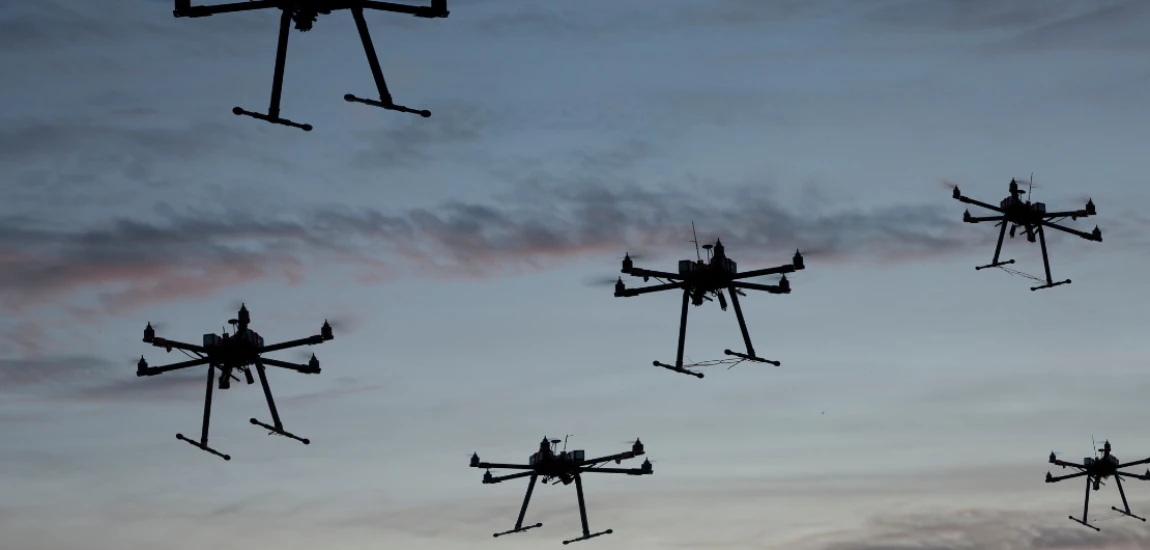
The rapid advancement of drone technology has transformed industries ranging from agriculture and logistics to defense, environmental monitoring, disaster management, and smart city infrastructure. Traditional drone systems were primarily designed for single-device operations controlled manually by human operators. While these drones improved efficiency in many sectors, they often faced limitations in scalability, coordination, and real-time autonomous decision-making.
As operational demands have increased, industries are now moving toward intelligent drone swarm coordination systems and autonomous aerial surveillance frameworks. These advanced technologies combine artificial intelligence, machine learning, swarm intelligence, IoT connectivity, edge computing, and autonomous navigation systems to enable multiple drones to operate collaboratively and intelligently in complex environments.
Drone swarms are inspired by the collective behavior of biological systems such as birds, bees, and ants. Instead of functioning independently, drones within a swarm communicate continuously, share environmental data, coordinate movements, and make collective decisions in real time.
Autonomous aerial surveillance frameworks further enhance these capabilities by integrating advanced sensors, predictive analytics, computer vision, and intelligent monitoring systems. These technologies enable drones to perform large-scale surveillance, environmental monitoring, emergency response, infrastructure inspection, and security operations with minimal human intervention.
AI-powered drone coordination systems are capable of adapting dynamically to changing environmental conditions, avoiding obstacles autonomously, and optimizing mission performance continuously. These innovations are reshaping modern aerial intelligence and creating new possibilities for automation across industries.
In this blog, we will explore the technologies, benefits, applications, challenges, and future developments of intelligent drone swarm coordination systems while understanding how autonomous aerial surveillance frameworks are transforming the future of intelligent aerial operations worldwide.
Understanding Intelligent Drone Swarm Coordination Systems

Evolution of Drone Technologies
Drone technology has evolved significantly over the past two decades. Early unmanned aerial vehicles were limited in functionality, relying heavily on manual remote control and basic navigation systems. These drones were primarily used for military reconnaissance and simple aerial photography tasks.
As sensor technology, wireless communication, and artificial intelligence advanced, drones became more autonomous and capable of performing complex operations such as automated flight planning, object detection, and real-time environmental monitoring.
Modern intelligent drone swarm coordination systems represent the next stage of technological evolution. Instead of relying on a single drone, swarm systems use multiple interconnected drones capable of operating collaboratively through AI-driven communication and decision-making networks.
These systems improve operational scalability, efficiency, and reliability in large and dynamic environments.
Artificial Intelligence and Swarm Intelligence
Artificial intelligence is the foundation of intelligent drone swarm systems. AI algorithms enable drones to process environmental data, recognize patterns, and make autonomous operational decisions.
Swarm intelligence is inspired by collective behavior found in nature. In drone swarms, each drone acts as an independent unit while continuously communicating with the entire swarm network.
Machine learning systems optimize drone formation control, task allocation, navigation routes, and environmental adaptation dynamically.
Swarm intelligence allows drone fleets to complete complex missions more efficiently than individual drones operating independently.
This collaborative approach enhances flexibility, resilience, and mission success rates.
Autonomous Communication and Coordination Networks
Communication is critical for effective swarm coordination. Intelligent drone systems use wireless communication protocols, mesh networking, and edge computing to maintain real-time connectivity between drones.
Autonomous coordination systems enable drones to share positional data, environmental observations, obstacle information, and mission updates instantly.
AI-powered coordination networks adjust drone formations dynamically based on operational conditions and mission objectives.
Real-time communication ensures synchronized swarm behavior and improves operational reliability in complex environments.
These capabilities are essential for large-scale surveillance and aerial intelligence missions.
Autonomous Aerial Surveillance Frameworks

Real-Time Environmental Monitoring Systems
Autonomous aerial surveillance frameworks are designed to monitor large geographical areas continuously and efficiently.
AI-powered drones use cameras, LiDAR sensors, thermal imaging systems, radar technologies, and environmental sensors to collect real-time aerial data.
These systems monitor traffic patterns, agricultural fields, forests, industrial facilities, wildlife habitats, and disaster zones autonomously.
Real-time monitoring improves situational awareness and supports faster decision-making across multiple industries.
Advanced aerial surveillance frameworks provide accurate environmental intelligence with minimal human involvement.
Computer Vision and Intelligent Object Detection
Computer vision technologies play a major role in autonomous aerial surveillance systems.
AI-powered image recognition systems analyze aerial images and video streams to identify objects, vehicles, people, infrastructure damage, environmental changes, and suspicious activities.
Machine learning algorithms continuously improve detection accuracy by learning from operational data and environmental conditions.
Computer vision enables drones to perform automated inspections, search-and-rescue operations, traffic analysis, and border monitoring tasks effectively.
Intelligent object detection significantly enhances surveillance efficiency and operational accuracy.
Predictive Analytics and Mission Optimization
Predictive analytics allows drone systems to forecast operational challenges and optimize mission performance proactively.
AI-powered analytics platforms analyze weather conditions, terrain data, flight patterns, and environmental risks to improve navigation and operational planning.
Predictive systems help drones avoid collisions, reduce energy consumption, and optimize surveillance coverage dynamically.
Mission optimization technologies improve flight efficiency, operational safety, and data collection quality.
These capabilities are especially valuable for long-duration and large-scale aerial operations.
Benefits of Intelligent Drone Swarm Systems

Enhanced Operational Efficiency and Coverage
One of the biggest advantages of drone swarm systems is their ability to cover large areas quickly and efficiently.
Multiple drones operating collaboratively can complete surveillance, mapping, and monitoring tasks significantly faster than single-drone systems.
AI-driven coordination optimizes task distribution and minimizes redundant operations.
Enhanced coverage improves operational productivity in industries such as agriculture, infrastructure inspection, environmental monitoring, and security management.
Swarm intelligence also improves mission scalability for complex operations.
Improved Disaster Response and Emergency Management
Drone swarms play a critical role in disaster response and emergency management operations.
During natural disasters such as floods, earthquakes, wildfires, and hurricanes, autonomous drones can monitor affected areas, identify survivors, and assess infrastructure damage rapidly.
AI-powered aerial systems provide emergency teams with real-time situational intelligence and optimize rescue coordination.
Drone swarms improve response speed, reduce operational risks, and enhance public safety during emergencies.
These systems are becoming essential tools for humanitarian operations and crisis management.
Reduced Human Workload and Operational Risks
Traditional aerial surveillance operations often require extensive human supervision and expose personnel to dangerous environments.
Autonomous drone systems reduce manual workload by automating navigation, monitoring, data analysis, and mission coordination tasks.
AI-powered drones can operate in hazardous environments such as wildfire zones, industrial facilities, radiation areas, and conflict regions without risking human lives.
Reduced operational risk improves worker safety and mission reliability significantly.
Automation also lowers operational costs and increases efficiency.
Applications of Autonomous Drone Surveillance Frameworks

Smart Agriculture and Precision Farming
Agriculture is one of the fastest-growing sectors for drone swarm technologies. AI-powered drone systems monitor crop health, soil conditions, irrigation patterns, and pest infestations in real time.
Swarm drones analyze large agricultural fields quickly and generate detailed environmental reports for farmers.
Precision farming technologies improve crop productivity while reducing water usage, pesticide application, and operational costs.
These systems support sustainable agriculture and food security initiatives worldwide.
Infrastructure Inspection and Industrial Monitoring
Drone swarms are widely used for inspecting infrastructure such as bridges, pipelines, power lines, railways, and industrial facilities.
AI-powered aerial inspection systems detect structural damage, corrosion, leaks, and operational anomalies automatically.
Autonomous drone inspections reduce maintenance costs and improve operational safety.
Industrial monitoring frameworks also support predictive maintenance and asset management operations.
These technologies increase efficiency in energy, transportation, and manufacturing sectors.
Border Security and Public Safety Operations
Government agencies and security organizations use autonomous aerial surveillance systems for border monitoring, crowd management, and public safety operations.
Drone swarms monitor large areas continuously and identify suspicious activities using AI-driven analytics and computer vision technologies.
Real-time surveillance improves law enforcement coordination and emergency response effectiveness.
These systems strengthen national security and urban safety infrastructures significantly.


Gary Arndt operates "Everything Everywhere," a blog focusing on worldwide travel. An award-winning photographer, Gary shares stunning visuals alongside his travel tales.
Gary Arndt

Prev Post

Next Post